· Marcus Vega
Hard, Soft or Glass Mousepad? Surface and Thickness for Gaming
Every mousepad conversation splits into two questions. The first is format — how much surface you need and where it goes — and that one is already handled in our desk mat vs mouse pad guide. This article takes on the second: the surface itself. Cloth, hard polymer and glass move a mouse in genuinely different ways, thickness changes more than comfort, and the sensor under your palm has opinions about all of it.
The three surface families, defined
Strip the marketing off and every gaming surface lands in one of three buckets.
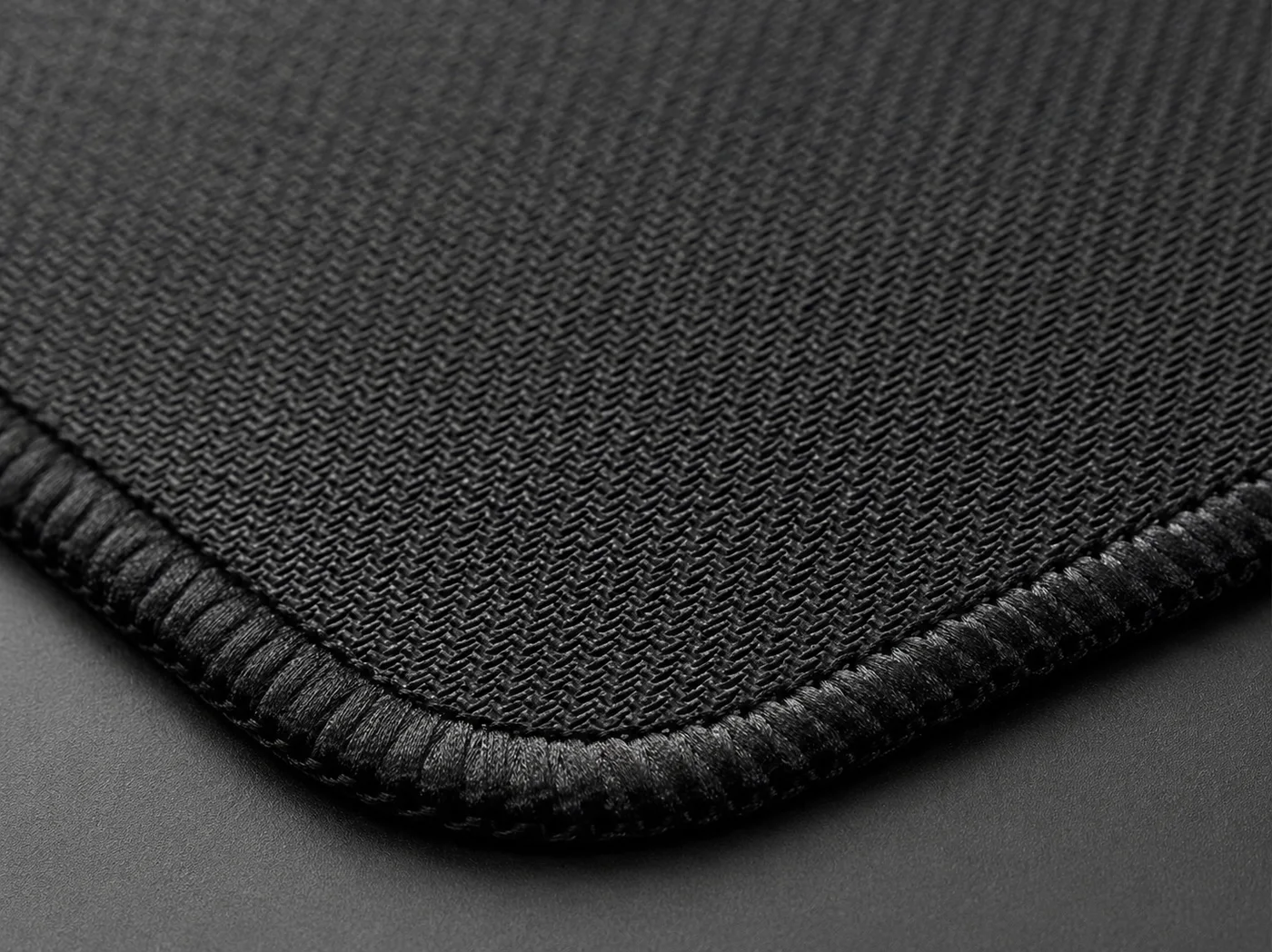
Soft cloth is a woven textile face bonded to a rubber base — the construction of every Deskaru mat. Mouse feet ride the peaks of the weave, and the fibers flex slightly under pressure. That flex is the defining trait: friction rises when you press down, which turns your grip into a brake you can feather.
Hard pads are a rigid sheet — usually a polymer — with a lightly textured coating. Nothing flexes: the mouse starts moving with less force and keeps gliding with less resistance, and pressing down harder changes very little. That is what people mean when they call hard pads fast and slippery in the same breath.
Glass pads take the hard-pad idea to its end point: tempered glass with a micro-textured finish. The texture exists so an optical sensor has something to read — it is what separates a glass gaming pad from a plain glass desktop. The glide is the lowest-friction of the three and it never changes: no wear patch, no humid-day slowdown, the same surface in year three as on day one.
The physical way to compare them is not fast versus slow — it is how much braking the surface gives back when you need to stop. Cloth gives the most, glass the least, and everything about who each family suits follows from that single trade.
How a mouse sensor reads a surface
A modern gaming mouse is a small camera pointed at the desk: it illuminates the surface, photographs its micro-texture thousands of times per second, and calculates movement by comparing consecutive frames. For that to work, the surface needs texture the camera can see.
A woven cloth face is the easy case: the weave is nothing but dense, high-contrast texture. Coated hard pads read well for the same reason, and textured glass works because the etching gives the sensor the detail plain glass lacks — a transparent, glossy desktop is the one common surface where tracking genuinely struggles, one reason a mat earns its place on a glass desk, as our guide to what a desk mat protects covers.
What the sensor rewards most, though, is uniformity: a surface that looks the same at every point tracks the same at every point. A bare wooden desk fails that test slowly — grain changes across the top, and the patch under your mouse hand gets polished by palm oils until it reads differently from the rest. The mouse still tracks; it just tracks on a surface that is quietly different from one week to the next.
This is why our print process keeps the weave at a fine, even gauge across all 36 inches, artwork or no artwork. The sensor does not care what the picture is. It cares that the texture at the left edge of a swipe is identical to the texture at the right.
Hard or soft: which is better for gaming?
The classic question has a real answer once you name the trade: a hard pad minimizes the force needed to start a movement, a cloth pad maximizes your ability to end one precisely. Which matters more depends on what your hands spend the game doing.
| Soft cloth | Hard / glass | |
|---|---|---|
| Starting a movement | Slightly more initial force | Near-instant, minimal force |
| Stopping precisely | The weave brakes for you | Your grip does all the braking |
| Pressing down mid-aim | More pressure = more control | Pressure changes little |
| Sound and feel | Quiet, warm under the wrist | Audible glide, cold contact |
| Surface over time | Glide mellows with use and washes back | Constant; feet wear instead |
| Forgiveness | High — overshoot is rare | Low — overshoot is the learning curve |
In practice: tracking heads through a spray pattern, micro-adjusting a long-range shot, working in a design tool — these are stopping tasks, and cloth is built for them. Raw low-sensitivity flicks, where you value the swipe more than the landing, are where a hard surface shines. But most hands in most games make small, constant corrections, which is why the fine-weave cloth on our XXL mats — quick enough to flick on, textured enough to brake on — is the balance we committed to. Within our own range, the same logic decides cloth versus PU leather: smooth PU tracks fine and glides fast, and woven cloth takes the aim-control crown.
Why do pros not use glass mousepads?
The observable fact first: on any tier-one FPS broadcast, the pads under the winning mice are overwhelmingly cloth. Not exclusively — a minority of competitive players run hard or glass and play brilliantly — but the default is fabric, for practical rather than mysterious reasons.
Stopping power is the job. Professional aim is mostly tiny corrections under pressure, and cloth returns braking force the moment you press into it. On glass, every stop is executed entirely by your grip — learnable, but it removes a safety net where the money is.
Muscle memory has a surface. Years of training hours calibrate thousands of micro-movements to how cloth responds; switching surfaces resets part of that, and mid-career is an expensive time to experiment.
Stages are hostile environments. A glass pad is loud under the mouse, cold under the wrist, unforgiving when gear drops on it, and it grinds through mouse feet faster than fabric does. A rolled cloth mat travels in a backpack and shrugs all of that off.
The nuance the internet flattens: glass is not a gimmick. Its consistency claim is real — no wear patches, no humidity drift, one glide forever. Pros skip it not because it fails, but because its one advantage solves a problem cloth players barely have, while its costs land exactly where a professional cannot afford them.
Are thicker mousepads better?
Thickness is where mousepad marketing loves a bigger number, so here is precisely what a millimetre buys — and what it charges.
What thickness gives you: cushioning under the wrist, and tolerance for an uneven desk — a thick pad bridges small dips that a thin one telegraphs. What it costs you: stability and flatness. A keyboard on a plush pad sinks and rocks when you bottom out keys, a thick mat holds the memory of its shipping roll longer, and deep cushion lets the sensor's height shift with how hard you press — small, but one more variable in a hobby about removing them.
thickness of every Deskaru XXL cloth mat — a printed textile face bonded to a textured non-slip rubber base, held by a stitched border
— Deskaru product measurements, 2026
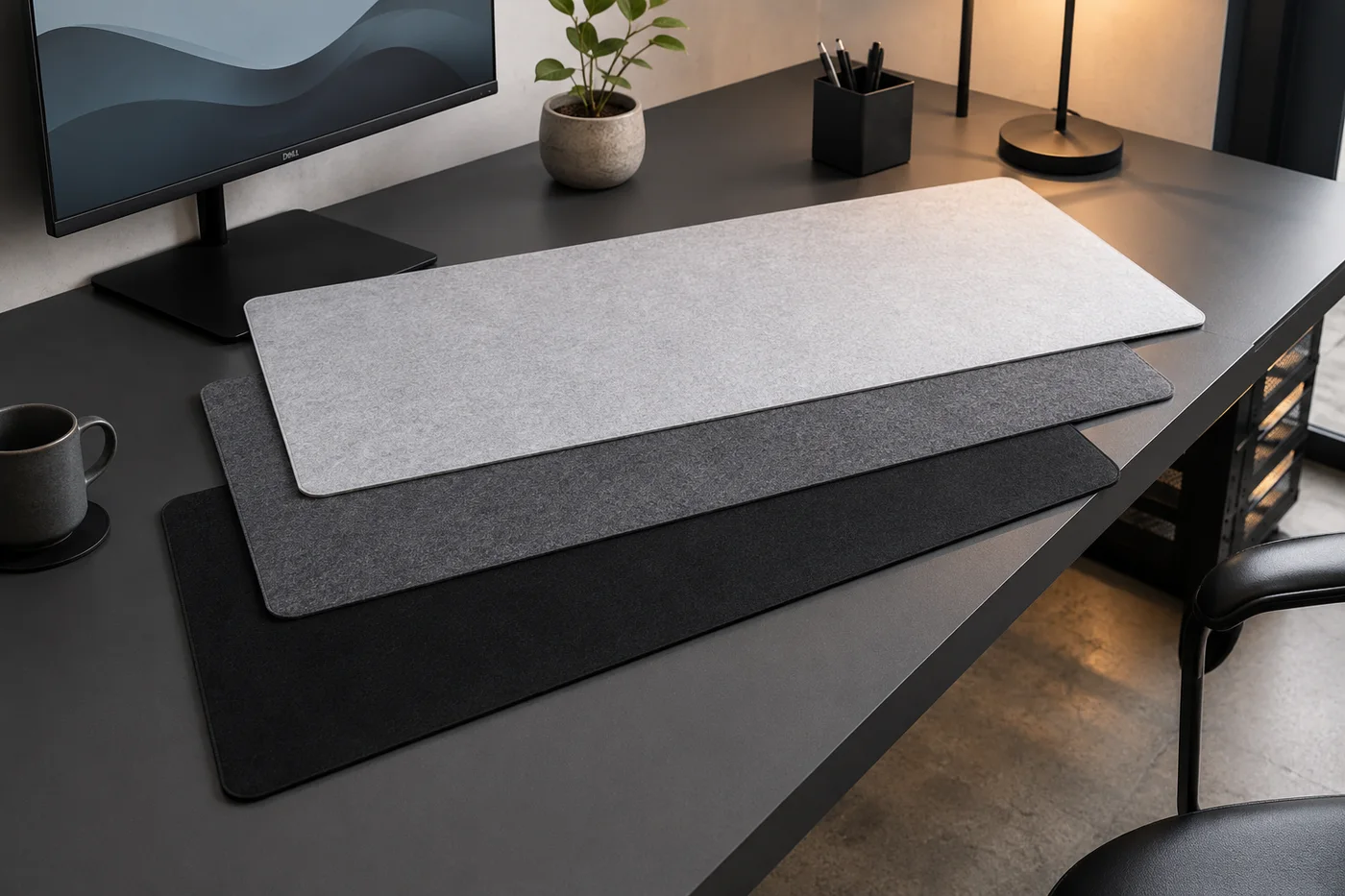
Two millimetres is where those curves cross, which is why every cloth mat we sell sits at exactly that number: flat out of the roll, keyboard planted, one sensor height everywhere, enough fabric to erase the hard desk under your wrists. Plush 4-5 mm pads feel indulgent for a day; then you notice the keyboard wobble, and it never un-notices itself. If your wrists want cushioning, the fix is a wrist rest on a stable mat, not a mushier mat.
One caveat: thickness is also a height change for your forearm — 2 mm disappears, while 5 mm can subtly change your typing angle. Our size guide covers the fit questions — width, depth, clearance — that decide comfort long before millimetres do.
Are mousepads necessary anymore?
The question comes from a real place: sensors got good, and on most wood or laminate tops a modern mouse tracks without complaint. So the case for a pad in 2026 is not "the mouse needs it to function." It is three quieter things.
Consistency. A desk is many surfaces pretending to be one: grain, finish, worn patches, the polished zone where your hand lives. A mat replaces all of it with one uniform texture, so the glide at the end of a swipe matches the glide at the start.
Stability. On bare wood, a keyboard migrates a few millimetres per session. A textured rubber base holds the mat, and the cloth holds the gear. One verified buyer put it plainly: "Smooth surface, good colors, anti-slip bottom, stitched edges. Pretty good overall."
Contact. Hours of forearm on a hard desk edge is the cost nobody prices in until hour three. A continuous cloth layer under wrists, keyboard and mouse changes what your arms touch all day — the full ergonomic case is in the guide linked above.
So no — a pad is not necessary the way a mouse is. It is necessary the way consistent conditions are: nothing else in the setup makes tracking, stability and comfort this predictable for $39.95.
Where that leaves your desk
The map is short. Glass suits a specific player: high-sensitivity, grip-braking confident, at peace with the noise. Hard polymer is the same family with a gentler learning curve. Plush pads solve a comfort problem a wrist rest solves better. For the immense majority of players — and every desk that games at night and works by day — a fine-weave cloth surface at 2 mm, stretched across the full keyboard-and-mouse zone, keeps every variable constant and asks nothing in return.
average rating across 18 verified buyer reviews on the Deskaru mat range
— Verified buyer feedback, 2026
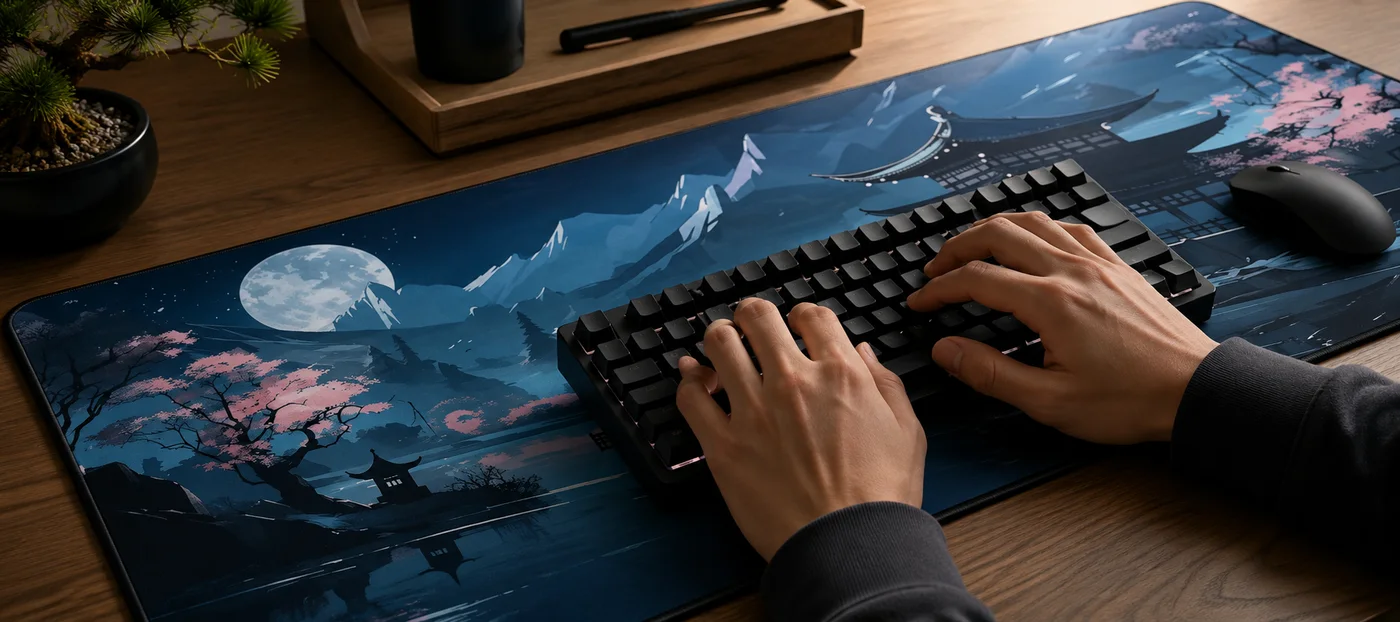
That is what we build: 36x16 inches of even weave, stitched edges, non-slip base, 18 HD-printed designs from the Japanese collection to plain competitive grays — $39.95, free shipping, 30-day money-back guarantee. The buyer feedback, photos included, lives on the reviews page.
Frequently asked questions
Are thicker mousepads better?
Not past a point. Extra millimetres add cushioning, but they also let a keyboard rock when you bottom out keys and they hold the curve of the shipping roll longer. A 2 mm mat lies flat, keeps the keyboard planted, and gives the sensor one consistent height across the whole surface.
Why do pros not use glass mousepads?
A few competitive players do run glass — its glide never changes with humidity or wear. Most stay on cloth because a woven surface gives more resistance to stop on for small corrections, matches the feel they trained on for years, and is quieter, warmer and kinder to mouse feet at a stage desk.
Which mousepad is better for gaming, hard or soft?
Soft cloth, for most players. A hard pad starts moving with less force, which feels fast, but it gives less resistance to brake against, so precise stops take more effort to learn. A fine woven surface starts quickly enough for flicks and stops predictably, which is what aim consistency is built on.
Are mousepads necessary anymore?
Modern optical sensors track on most bare desks, so a pad is no longer about making the mouse work. It is about making the read consistent: one even texture instead of wood grain and polished patches, a keyboard that stays put, and cloth instead of a hard edge under your forearms.
Bottom line: surfaces are a braking decision, thickness is a stability decision, and the sensor just wants uniformity. Soft fine-weave cloth at 2 mm answers all three for nearly everyone, which is the entire design brief behind our XXL mats. Pick a design in the 2026 buyer's guide.

Marcus Vega · Setup Lead at Deskaru
Marcus has built and torn down more battlestations than he can count. He writes the Deskaru setup guides.