
· Marcus Vega
Why a Desk Mat Curls at the Edges, and How to Flatten It
This question lands in my inbox more than any other, usually within an hour of a parcel being opened: the mat comes out of the tube, goes on the desk, and the two short ends sit up like a book that will not stay shut.
What is actually holding that curve
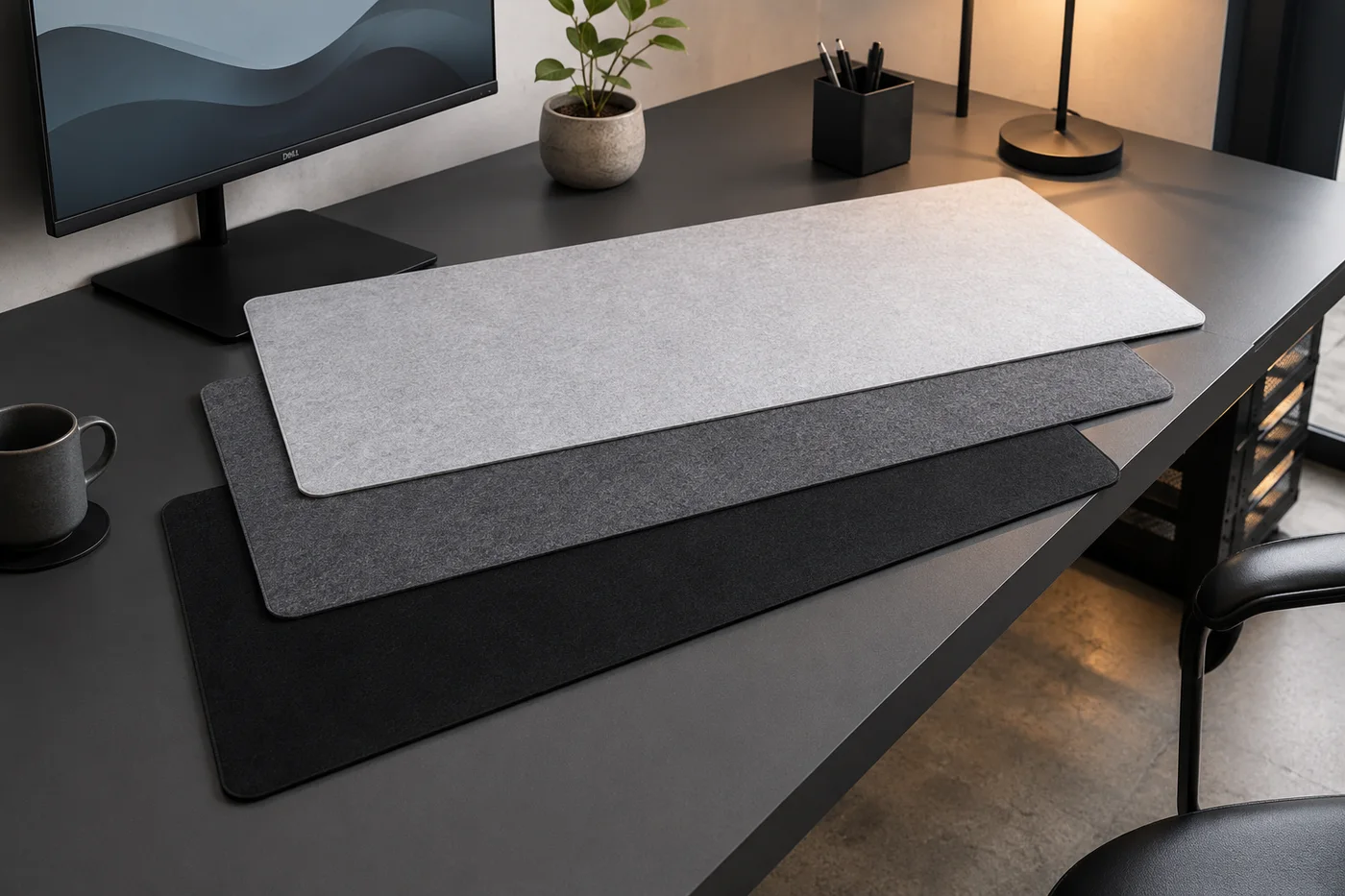
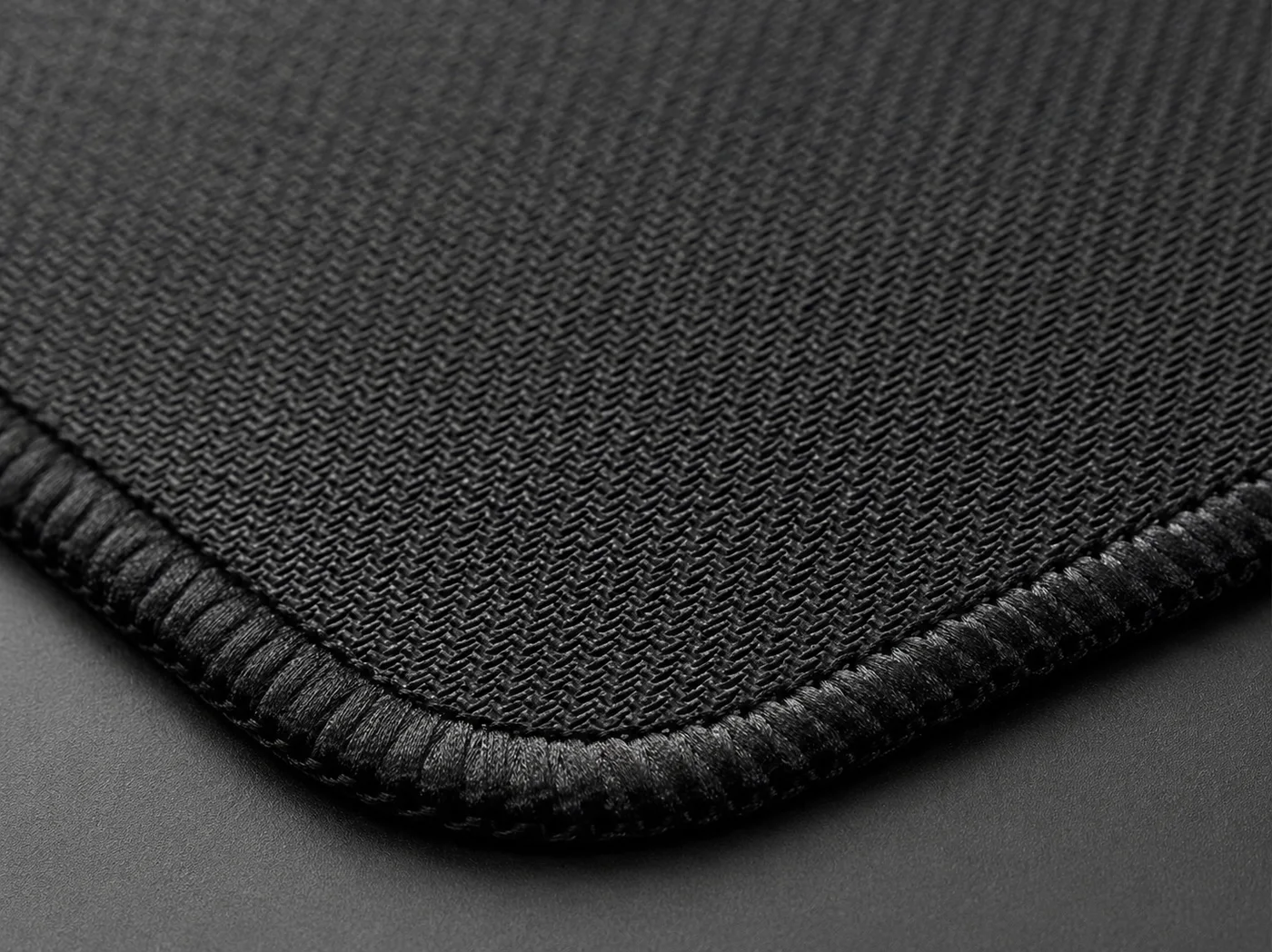
A Deskaru mat is three layers: a fine-weave textile carrying the HD print, a textured non-slip rubber base underneath, and a stitched border locking the two together around the whole perimeter.
total thickness of the XXL mat — a printed textile face bonded to a textured rubber base, held by a stitched border
— Deskaru product measurements, 2026
Rolled, those two faces travel different paths. The outer surface takes a longer arc than the inner one, so one layer sits under mild tension and the other under mild compression for as long as the mat is in the tube. Hold layered material like that and it starts treating the curve as its resting shape.
Which layer does the remembering is what matters. The woven face has almost none — fabric drapes, and it lies down on whatever you put it on. The rubber base holds the shape, because elastic things store the position you leave them in. The curve therefore sits in the layer facing away from the print, and releasing it never means touching the artwork.
Why a 36-inch mat ships rolled and never folded
There are two ways to get 36 by 16 inches of stitched mat into a parcel, and only one of them is reversible.
Rolling puts a single continuous curve through the material: everything bends by the same gentle amount, nothing bends sharply, and when the tension comes off it returns toward flat everywhere at once. Folding concentrates the whole bend into a line a couple of millimetres wide, crushing the weave and creasing the base for good. A curve relaxes. A crease is a scar.
So the tube is why mats turn up looking like the photos. One verified buyer on the Japanese line wrote: "Arrived quickly. Feels like it's of good quality, the edges don't curl up. I'm completely satisfied."
average rating across 18 verified buyer reviews on the Deskaru mat range, where arriving flat and crease-free is a recurring theme
— Verified buyer feedback, 2026
The flattening methods, safest first
Work down this list in order. Most mats never need step three.
- Let it reach room temperature. The step everyone skips, and in the colder months it does most of the work by itself. A parcel that spent days in an unheated van arrives cold, and cold rubber is stiffer than warm rubber. Lay the mat print side up and leave it.
- Reverse the roll. The most effective single action. Roll the mat the other way — print side facing outward — loosely, without cinching it tight, hold it, then let it open on the desk. You are asking the base to store the opposite curve for a moment, which cancels most of what it held.
- Lay it flat and load the ends. Print side up, weight on the two ends that lift: books, a monitor stand, anything broad and flat. Keep to flat-bottomed objects: a hard rim presses a dent into 2 mm of fabric that outlasts the curl.
- Then just use it. A keyboard, a mouse and two forearms are a well-distributed weight applied for hours a day, which is exactly the load you want. The base grips the desk, the gear holds the ends, and the question answers itself.
- Gentle warmth means a warm room. Warm the room the mat sits in — that is the entire method. It never means applying heat to the mat itself; an appliance held against a print is not a faster version of a warm room.
If I had to keep one step it would be the reverse roll. The rest is patience, and patience works, but reversing the curve acts directly on the layer holding it.
What never to do to a curled desk mat
Every entry below turns something temporary into something permanent, by one mechanism: heat and sharp bends change the base itself, and the base is the part that cannot be undone.
- An iron, at any setting, with or without a cloth. The suggestion I see most often, and the worst. It puts concentrated heat onto an HD print and the rubber beneath it, deforming the base in exactly the way you were trying to fix.
- A hair dryer, a radiator, a heat gun or a sunny windowsill. Same mechanism, applied more slowly. Direct sun is the sneakiest because it feels harmless and works on both print and base over days.
- Hot water. Soaking a mat to relax it is a wash it did not need, at the temperature that does the most damage. If it genuinely needs cleaning, the routine is in our desk mat cleaning guide.
- Folding it, or cranking a tight reverse roll. Folding swaps a curve you can release for a crease you cannot, storage included. A tight reverse roll left in place teaches the base a new curve the other way.
- Heavy objects with hard edges or small feet. Anything with a rim concentrates its weight into a small ring and embosses the weave.
How long it takes, and the test that beats a clock
I am not going to give you a number, because the number would be fiction. How long a mat takes to settle depends on how tightly it was wound, how long it stayed that way, how cold it was when it reached you, and how much weight you put on it — variables that move the answer far too much for one figure.
What you can rely on is a two-second test. Lift the weight off one end and watch the corner. If it stays where you put it, the base has let go and you are finished. If it climbs, put the weight back and carry on with your day.
The ranking by speed holds even when the timings do not: the reverse roll acts immediately and does the largest share in one pass, weight on the ends works steadily for as long as it stays there, and leaving a mat alone is the slowest and still perfectly effective.
When the edge is lifting for a different reason
Not every raised edge is roll memory. These three have their own fixes.
The mat overhangs the desk. If a mat is deeper or wider than the surface it sits on, the part hanging past the edge folds down under its own weight. That is a fit problem wearing a curl costume. Our desk mat size guide does the measuring: a 36 by 16 inch mat wants a desk of about 40 inches or more.
Something is trapped underneath. A cable, a crumb or a build-up of grit under the base lifts a corner locally and holds it there. The tell is that the lift sits in one spot rather than across a whole end. Lift the mat off, sweep the desk, put it back — a habit worth keeping anyway, as our guide to what a desk mat protects your desk from explains.
It dried unevenly after a wash. A mat dried hanging or draped can ripple along the border, because the stitched perimeter holds moisture longer than the open weave. Drying the whole mat flat is the fix.
That border is why none of this becomes permanent on a stitched mat: the perimeter thread locks the textile to the rubber around the entire edge, so the two layers cannot part company. An unstitched pad has no such lock — its edge frays, peels and lifts for good.
The one curl that does not come back flat
There is a single failure mode where a lifted corner is permanent, and it is entirely under your control.
A tumble dryer, on any setting, combines heat with mechanical tumbling. That degrades the bond between textile and rubber and warps the base into a shape it keeps. A corner curled that way never fully flattens again, and no amount of weight or time recovers it. The difference in one line: the tube gives you a curve the base is still holding, while a dryer gives you a base that has changed shape. The first releases. The second does not.
Which is why the care routine here converges on one instruction: air-dry flat, at room temperature, always.

Keeping it flat once it is down
Keeping it that way takes almost nothing: the textured rubber base does most of the work by refusing to move at all.
- Lift it, never drag it. Sliding a mat back into alignment pulls the base against the desk and against whatever grit is under it.
- Store it rolled, loosely, print side out. For a move or a desk rebuild, roll it the way it arrived rather than folding it. Print side outward puts the base on the inside, the layer you would rather not stretch.
- Watch the cold months. From October to December most parcels travel in cold weather. Nothing about that harms a mat, but a cold mat is a stiffer mat, and the room-temperature step earns its place.
None of this is specific to one design: everything we print shares a construction, so the Japanese collection, the plain colours and a custom XXL behave identically. The PU leather mat differs only in degree.
Frequently asked questions
My desk mat arrived rolled up. Is that normal?
Yes — that is how a 36 by 16 inch mat travels without picking up a crease. A tube holds one continuous curve, and a curve relaxes. Folding would put a hard line across the print instead, and that line never comes out.
Can I iron a desk mat to flatten it?
No. An iron puts concentrated heat straight onto an HD print and a rubber base, and heat is the one thing that turns a temporary curve into a permanent deformation. The same goes for a hair dryer, a radiator and direct sun.
What is the fastest way to flatten a curled desk mat?
Roll it loosely the opposite way, hold it, then let it open on the desk print side up and put weight on the ends — books, a monitor stand, or simply your keyboard and mouse. Reversing the curve acts on the layer that is holding it.
Does the PU leather desk mat behave the same way?
It ships rolled like every other mat and opens flat the same way. Its face is smooth PU rather than woven textile, so it shows the curve less across the middle and concentrates it at the two short ends. Weight there is all it asks for.
Bottom line: the curve comes from the tube, lives in the rubber base, and comes out with a reverse roll, weight, and the mat being used. Keep heat and folds away and the edge you have on day one is the edge you keep. Every Deskaru mat is 36 by 16 inches, 2 mm thick and stitched all the way around at $39.95, with free shipping and a 30-day guarantee — read what buyers say on the reviews page.

Marcus Vega · Setup Lead at Deskaru
Marcus has built and torn down more battlestations than he can count. He writes the Deskaru setup guides.